


Study Duration
Tow academic years
Credit Hours
75 credit hours
Degree Type
Diploma
Language of Study
Arabic & English
Program Overview
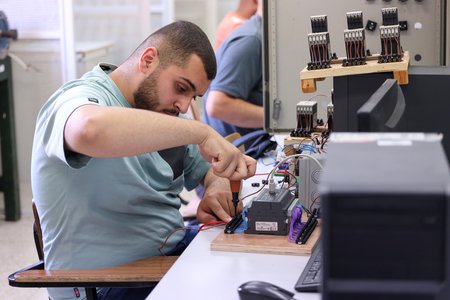
The Electrical Installations Engineering program prepares technicians to design, install, inspect, and maintain electrical systems in residential, commercial, and industrial buildings, including lighting, distribution boards, motors, and control circuits.
Graduate Profile
Graduates of this program will be able to:
- Design and implement electrical installations for residential, commercial, and industrial projects.
- Design and execute traditional and programmable industrial control circuits.
- Draft electrical schematics using computer-aided design (CAD) tools.
- Design and install renewable energy systems.
- Work with both low- and high-voltage networks.
- Handle protection, safety, and alarm systems effectively.
Graduate Career Fields
Graduates of Electrical Installations Engineering can work in a wide range of fields, including:
- Electrical contracting companies.
- Power supply and distribution companies.
- Industrial factories.
- Public and private sector institutions.
- Electrical engineering laboratories at universities and technical colleges.
- Teaching positions in industrial schools within the field of electrical engineering.
- Sales and marketing of electrical devices and equipment.
- Supervising electrical technicians in projects.
- Freelance or self-employed electrical contracting.
Admission Requirements
- General Secondary Certificate (scientific, industrial, or vocational stream).
Study Plan & Course Descriptions
The study plan covers electrical circuits, installation techniques, electrical machines, industrial control, PLC fundamentals, and electrical codes, alongside workshop practice, a graduation project, and field training.
Study Plan
Related Programs
 Diploma
 Diploma
Auto-Mechatronics
 Diploma
Cybersecurity technology
Cybersecurity Technology The Cybersecurity Technology program aims to equip students with the integrated knowledge and skills needed to protect computer systems and networks in organizations and institutions against cyber threats. The program focuses on developing graduates’ competencies in several key areas, including: Contributing to the development of institutional security and protection policies. Managing user access and implementing security systems. Conducting penetration testing and identifying network vulnerabilities. Designing and building wired and wireless computer networks. Managing computer networks and user accounts centrally through specialized server operating systems. Writing code for specialized computer applications.